Blog
Film Index
Paata Iakashvili on the First Georgian Fiction Film
The following text is an English translation of an article by Georgian film scholar Dr. Paata Iakashvili (1955–2022) published in 1977 in Georgian-language journal Kino [კინო].¹ It provides little-known facts and personal accounts about the lost film ბერიკაობა-ყეენობა / Berikaoba-Keenoba (1909, director Aleqsandre Tsutsunava). Named after a masqueraded folk play, the film was commonly believed to be a chronicle that simply captured the folk festival’s costumed processions. Iakashvili’s compelling analysis demonstrates that Berikaoba-Keenoba was in fact a fiction comedy involving an impressive number of professional actors, including Valerian Gunia and Lado Gvishiani. It was produced by an all-Georgian crew, possibly with the exception of a cameraman invited from Moscow, whose identity remains unknown. While Aleqsandre Tsutsunava’s another project, partially extant social drama ქრისტინე / Qristine (1918), is often referred to as the first Georgian fiction film, Berikaoba-Keenoba predates its release by almost a decade. Despite the article being published nearly 50 years ago, Berikaoba-Keenoba remains overshadowed. The film is referenced in Irakli Makharadze’s Georgian-language book The Great Silent: History of Georgian Silent Cinema but is still either marked as a documentary or absent from most of the English-language sources.² The publication of Iakashvili’s article’s translation could hopefully help to reintroduce the film to the new audience.
I would like to express deep gratitude to my friend Giorgi Chubinidze for proofreading and correcting the article’s machine translation and to film scholar Salome Tsopurashvili for sharing her opinion on the article’s findings.
The Film Berikaoba-Keenoba
by Paata Iakashvili
Eighty years ago, on November 16, 1896, Georgian audiences saw the first motion pictures by the founders of cinema, the Lumiere brothers.
This new form of art quickly gained popularity in Georgian society. Already in 1908, Vasil Amashukeli laid the foundation for Georgian documentary cinema, and A. Sebastianski and A. Digmeli followed in his footsteps. In 1912, V. Amashukeli shot the documentary film Akaki’s Journey to Racha-Lechkhumi, which was a unique event in the cinematography of that time. In 1915-1917, G. Gogitidze laid the foundation for the Georgian film industry, founded a film studio and on its base shot the feature film Qristine.
The above shows how quickly cinema gained recognition in Georgia. It is a great merit of Georgian film enthusiasts that they laid the strong foundation for Georgian national cinema.
In this article, we would like to express several thoughts on a Georgian film of this period, Berikaoba-Keenoba, which has been almost unknown until now and is not mentioned in specialized literature. According to the widespread opinion among Georgian film scholars, the film must have been a documentary and depicted a Georgian folk play [sakhioba].
We have located several documents that, through critical examination, can be used to determine the date of filming, characters, theme, and genre of the film.
The first document about the film is L. Kvirchishvili’s article “Berikaoba-Keenoba on the Screen”, a photocopy of which is available. The article was published in a newspaper; unfortunately, the title of the newspaper and the date of publication cannot be determined from the photocopy. The second document is a written memoir about the aforementioned film by film participant Vladimer (Lado) Gvishiani.
L. Kvirchishvili’s article provides us with the following information:
In 1909, in the village of Surami, Khashuri district, at the end of August, director M. Kvaliashvili began shooting the chronicle film, “Berikaoba-Keenoba”. The script for the film was specially created by the prominent Georgian writer and public figure Shalva Dadiani.
It is noteworthy that the script envisaged many actors, with their number exceeding a hundred. Residents of nearby villages also joined the filmmakers, and their mass participation became a truly important factor.
The main roles were played by: D. Abdusheli (Berika-Keeni), N. Bakuradze (Queen), Vl. Gvishiani (Bretsia-Kiliki), Al. Dondua (Feria). The following actors participated in individual roles: N. Mzhavanadze, N. Kacharava, I. Shurghaia and others. The film was shot by a cameraman specially invited by Sh. Dadiani from Moscow, who was consulted on the matter by the prominent Georgian director Al. Tsutsunava. The audience warmly received this film at the time.
It seems that L. Kvirchishvili’s article was not contemporary with the film’s shooting (1909) and was written later. The author relies either on personal memories or on some other source; nevertheless, we considered the article a reliable document. The article contains previously unknown facts that are worthy of attention. At the same time, it features a certain contradiction, the explanation of which could clarify many issues. First: was the film a chronicle, or did Sh. Dadiani specially create a script for it and were certain roles performed by known actors of the Georgian theatre? As far as we know, chronicle films of that period were unscripted, and a cameraman shot everything without any script. To establish this, we shall refer to the second document at our disposal – the memoir about the film by Vl. Gvishiani, the performer of the role of Bretsia-Kiliki.
In 1909, at the invitation of Valerian Gunia, the coryphaeus of the Georgian theatre, I took part in the first Georgian “igrovoi” [Russian for “fiction” – SK] film Berikaoba-Keenoba, whose script was written by Sh. Dadiani. The film was directed by Al. Tsutsunava, who had just arrived from Moscow. The expenses for shooting the film were covered by Mitrofane Kvaliashvili; V. Gunia, who at that time was with a troupe of Georgian actors near the film shooting location, in Surami, provided great assistance to the initiators of the film shooting. He allowed the actors of his troupe, including myself, to participate in the film, in which he himself also took part (in the role of a merchant). The film Berikaoba-Keenoba was shot in August 1909 in the village of Surami. Some footage for the film was shot in Western Georgia in the valley of the river Tskhenistsqali (near Abasha), as well as for a couple of days in Chokhatauri district and elsewhere. A Moscow cameraman was invited for the film.
The memoir is followed by the same list of actors and their roles in the film. We will return to the memoir of Vl. Gvishiani later. Let’s consider the above. As we can see, both documents mostly agree with each other, although there are some factual differences, but they complement rather than deny each other. First of all, Vl. Gvishiani’s memoir answers the question, whether the film was a chronicle or a fiction. Vl. Gvishiani’s memoir directly calls it fiction (“igrovoy”, as fiction films were called in Russian at the time and later). This explains the awkwardness in L. Kvirchishvili’s article, where the work with the features of a fiction film is called a chronicle. The idea of the film’s fictional nature is strengthened by the description of several scenes in Vl. Gvishiani’s memoir. Specifically, by the comical adventure of Bretsia-Kiliki, whom Gvishiani played himself:
The wife entrusts Bretsia-Kiliki with buying a milking goat. Kiliki goes to the market and buys a female goat; it gets dark and he spends the night with some family. The host secretly replaces the milking goat with a male goat; upon his return home, the wife scolds him.
According to the memoir, Kiliki has to buy a goat several times, but it always gets replaced. As Gvishiani adds, these scenes, along with the entire script, were written by Sh. Dadiani. Thus, all of it rules out the film being a chronicle and it is possible to doubtlessly claim that the authors of the film did not capture the Berikaoba-Keenoba festival on film, but created an independent work around the topics of the carnival performance.
In connection with the hypothesis of the film’s fictional nature, we may present one more fact: as Prof. D. Janelidze, a researcher of the folk origins of Berikaoba-Keenoba, informs us, the Berikaoba-Keenoba festival was held in spring, not in summer. Therefore, the authors of the film could not have shot a documentary about Berikaoba in August.
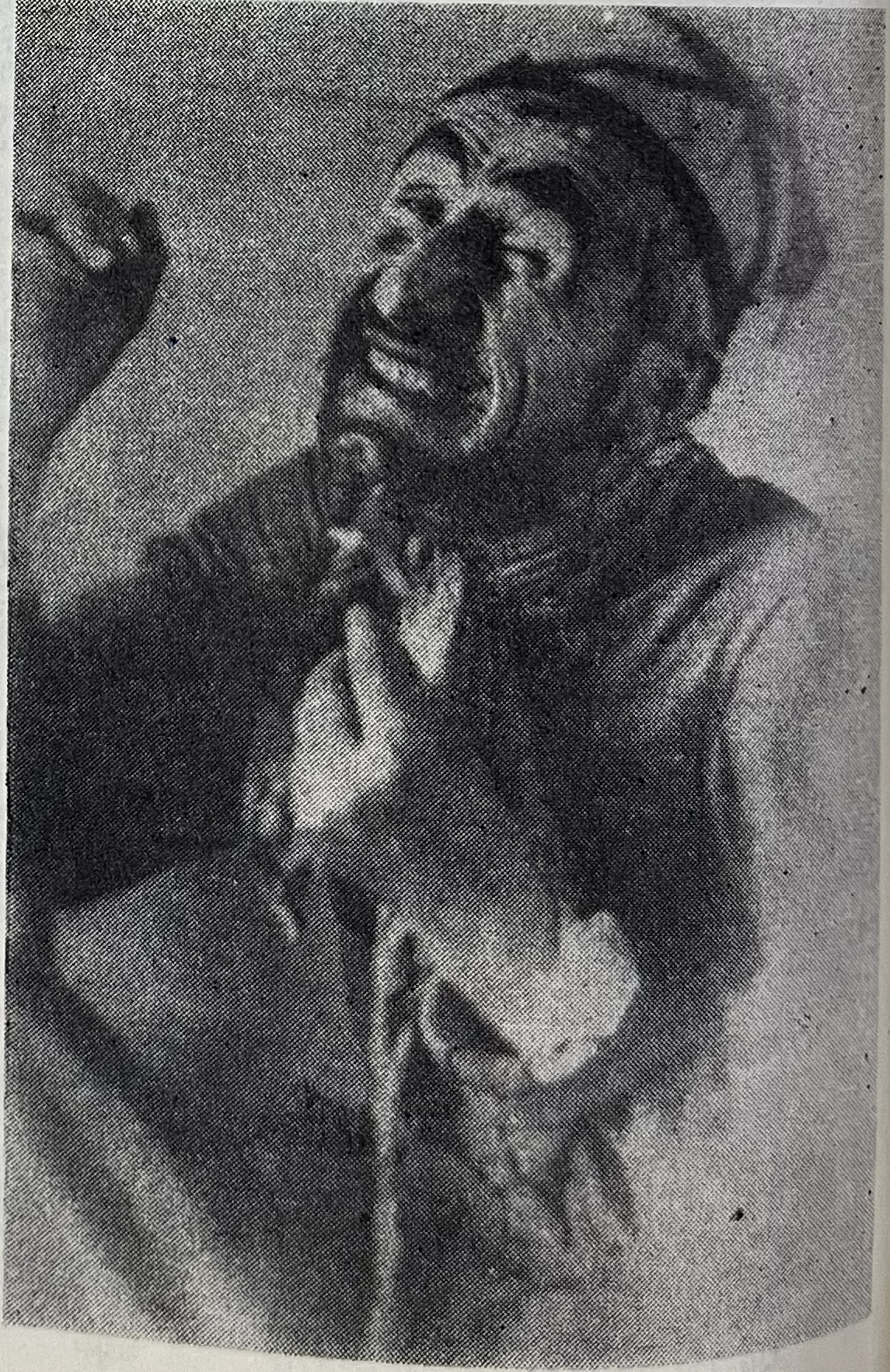
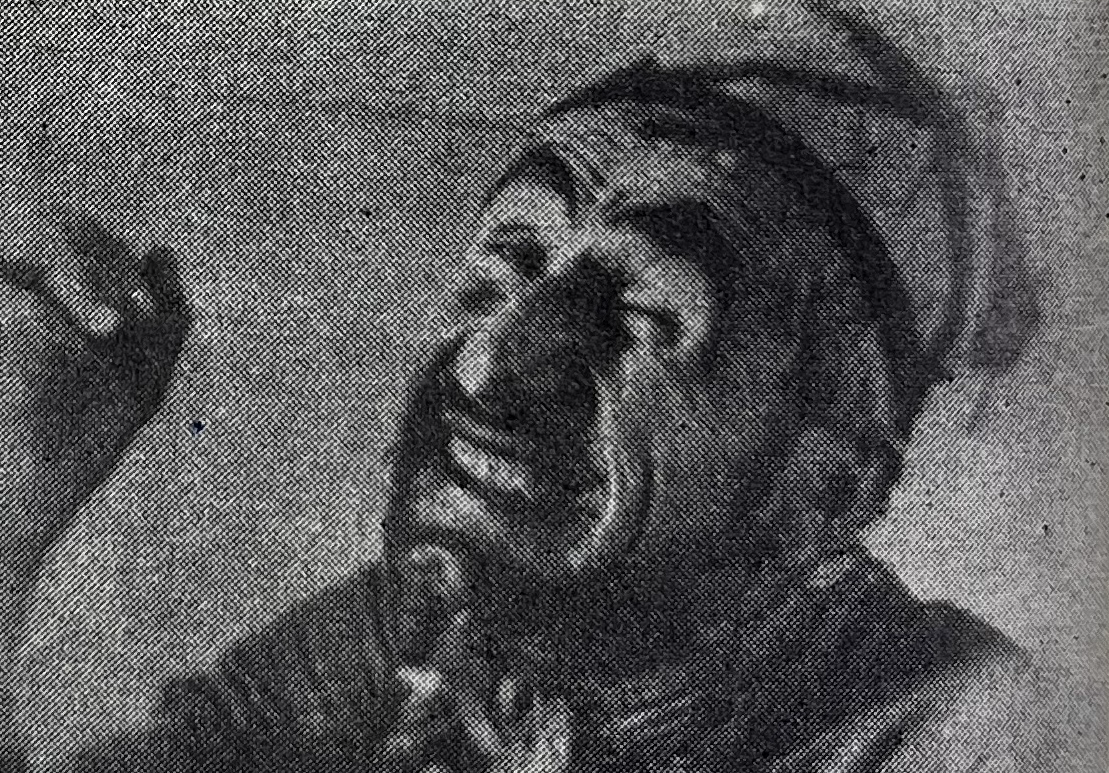
We read one more detail in Vl. Gvishiani’s memoir: “We performed the roles without masks – with makeup.” This is also confirmed by the single remaining image from the film. Vl. Gvishiani in the role of Bretsia-Kiliki, where the actor is pictured not with a mask characteristic of the Georgian folk plays, but with makeup. This once again confirms the fact that Berikaoba-Keenoba was merely the material for the work. Vl. Gvishiani’s memoir provides noteworthy information about the film – he names Aleksandre Tsutsunava as the director. Here Gvishiani’s memoir is contradicted by Kvirchishvili’s article that names M. Kvaliashvili as the director. We consider L. Kvirchishvili’s information doubtful, because in theatre studies literature, no director named Kvaliashvili is known at the time, therefore we find Vl. Gvishiani’s information convincing that Mitrofane Kvaliashvili only financed the production. As for the director of the film, Al. Tsutsunava’s candidacy must be more credible. Al. Tsutsunava returned from Moscow exactly that year. On June 26, 1909, he staged the acclaimed play by D. Annunzio, The Daughter of Iorio. Al. Tsutsunava’s stage pieces were characterized by mass participation, which was also the case in the film Berikaoba-Keenoba and was even noted by L. Kvirchishvili in his article. Therefore, it is conceivable that Tsutsunava did more in the film than just provide guidance to the cameraman, as L. Kvirchishvili writes, i.e. he was the director of the film.
Another noteworthy fact is the mention in Vl. Gvishiani’s memoir of V. Gunia, a great helper to the film’s authors. As we know, a well-known figure of the Georgian theatre, V. Gunia, was among the theatricals who approached cinema art from the very beginning. In 1913, V. Gunia took part in the film The Conquest of the Caucasus, where he played several roles. He is also the author of one of the early Georgian cinema scripts Brother and Sister, based on his own play of the same name. Until now we had no facts about V. Gunia’s relationship with cinema in an earlier period, and in this regard Vl. Gvishiani’s memoir is very interesting. V. Gunia must have met the initiators of Berikaoba-Keenoba’s production during the tours of Georgian theatre actors in the internal regions of Georgia at the end of July 1909. The actors also visited Surami during the tour, near which the film shooting was taking place. The newspaper Droeba provides information about this on July 24, 1909, in an informational note titled “Tour of Georgian Artists”.
It is noteworthy what genre Berikaoba-Keenoba belongs to. In resolving this issue, we must again rely on the memoirs of Vl. Gvishiani, where the author writes: “there were many comedic situations in the film and in general, the film was comedic”. The role of Bretsia-Kiliki, played by Vl. Gvishiani himself was also comedic, which is evidenced already by the excerpt from the script mentioned above in Vl. Gvishiani’s memoirs. So, we can conclude that the genre of the film was comedy. But in this case, we cannot get to the truth unless we pay attention to the following: Berikaoba-Keenoba, the folk play about which the film was made, was a social phenomenon. For the film’s dramatist, Sh. Dadiani, the issue was not unfamiliar; later he even wrote about the social aspect of Berikaoba-Keenoba the folk play in the article “A Significant Exhibition” published for the exhibition dedicated to the folk origins of the Georgian theatre. “The exhibition shows how many varieties one folk play had and with what social and political content this performance was imbued” (newspaper Komunisti. 1938. Oct 18. No 235). Since Sh. Dadiani assessed Berikaoba-Keenoba in this manner, we believe he would have shaped the film’s dramaturgical foundation not as a simple comedy, but as a social comedy, thereby doubling the significance of the aforementioned film. The likelihood of Sh. Dadiani shaping Berikaoba-Keenoba as a social comedy is further supported by the fact that later, in 1925, when he wrote the script for K. Marjanishvili’s film Before the Hurricane, the Berikaoba-Keenoba scenes depicted within it were given a certain social resonance.
From all of the above, we can conclude: in August 1909 (both primary sources name the same date for the film’s shooting, therefore we recognize it as truth), on the initiative of Sh. Dadiani and with his script, under the direction of Al. Tsutsunava, a feature film – the social comedy Berikaoba-Keenoba was shot on the theme of the Georgian folk play, Berikaoba-Keenoba. This itself determined the title of the film. The funds for shooting the film were provided and a certain initiative was shown by the patron Mitrofane Kvaliashvili, and with this he appears as the first Georgian producer. Participating in the film were: D. Abdusheli (Berika-Keeni), N. Bakuradze (Queen), V. Gunia (Merchant), and Vl. Gvishiani (Bretsia-Kiliki). The role performed by Vl. Gvishiani is the first comedic role in Georgian cinema. Besides them, participating in the film were: Al. Dondua (Fairy), N. Kacharava, I. Shurghaia, L. Javakhishvili and others.
Thus, we express the bold opinion that the film Berikaoba-Keenoba represents the first Georgian fiction film.
Both sources at our disposal – Kvirchishvili’s newspaper article and Vl. Gvishiani’s memoir – name almost the exact same actors. Unfortunately, the authors provide us with no other information regarding who D. Abdusheli, N. Bakuradze, Al. Dondua, N. Mzhavanadze, N. Kacharava, I. Shurghaia, and L. Javakhishvili were.
We found information about the aforementioned actors in the Theatre Museum. They initially belonged to amateur troupes, and from the 1930s they worked mainly in provincial theatres.
We could not find any other additional information about these actors. As we continue our research on the film Berikaoba-Keenoba, we will gladly accept any corrections and new information about the film and the actors participating in it.
Suggested Citation
Korotkova, Stasya. “Paata Iakashvili on the First Georgian Fiction Film.’” In Daydreams Database: Cinema of the Russian Empire and Beyond, edited by Anna Kovalova, developed by Alexander Grebenkov, 2026. URL: https://daydreams.museum/en/blog/paata-iakashvili-on-the-first-georgian-fiction-film/.
Paata Iakashvili on the First Georgian Fiction Film
The following text is an English translation of an article by Georgian film scholar Dr. Paata Iakashvili (1955–2022) published in 1977 in Georgian-language journal Kino [კინო].¹ It provides little-known facts and personal accounts about the lost film ბერიკაობა-ყეენობა / Berikaoba-Keenoba (1909, director Aleqsandre Tsutsunava). Named after a masqueraded folk play, the film was commonly believed to be a chronicle that simply captured the folk festival’s costumed processions. Iakashvili’s compelling analysis demonstrates that Berikaoba-Keenoba was in fact a fiction comedy involving an impressive number of professional actors, including Valerian Gunia and Lado Gvishiani. It was produced by an all-Georgian crew, possibly with the exception of a cameraman invited from Moscow, whose identity remains unknown. While Aleqsandre Tsutsunava’s another project, partially extant social drama ქრისტინე / Qristine (1918), is often referred to as the first Georgian fiction film, Berikaoba-Keenoba predates its release by almost a decade. Despite the article being published nearly 50 years ago, Berikaoba-Keenoba remains overshadowed. The film is referenced in Irakli Makharadze’s Georgian-language book The Great Silent: History of Georgian Silent Cinema but is still either marked as a documentary or absent from most of the English-language sources.² The publication of Iakashvili’s article’s translation could hopefully help to reintroduce the film to the new audience.
I would like to express deep gratitude to my friend Giorgi Chubinidze for proofreading and correcting the article’s machine translation and to film scholar Salome Tsopurashvili for sharing her opinion on the article’s findings.
The Film Berikaoba-Keenoba
by Paata Iakashvili
Eighty years ago, on November 16, 1896, Georgian audiences saw the first motion pictures by the founders of cinema, the Lumiere brothers.
This new form of art quickly gained popularity in Georgian society. Already in 1908, Vasil Amashukeli laid the foundation for Georgian documentary cinema, and A. Sebastianski and A. Digmeli followed in his footsteps. In 1912, V. Amashukeli shot the documentary film Akaki’s Journey to Racha-Lechkhumi, which was a unique event in the cinematography of that time. In 1915-1917, G. Gogitidze laid the foundation for the Georgian film industry, founded a film studio and on its base shot the feature film Qristine.
The above shows how quickly cinema gained recognition in Georgia. It is a great merit of Georgian film enthusiasts that they laid the strong foundation for Georgian national cinema.
In this article, we would like to express several thoughts on a Georgian film of this period, Berikaoba-Keenoba, which has been almost unknown until now and is not mentioned in specialized literature. According to the widespread opinion among Georgian film scholars, the film must have been a documentary and depicted a Georgian folk play [sakhioba].
We have located several documents that, through critical examination, can be used to determine the date of filming, characters, theme, and genre of the film.
The first document about the film is L. Kvirchishvili’s article “Berikaoba-Keenoba on the Screen”, a photocopy of which is available. The article was published in a newspaper; unfortunately, the title of the newspaper and the date of publication cannot be determined from the photocopy. The second document is a written memoir about the aforementioned film by film participant Vladimer (Lado) Gvishiani.
L. Kvirchishvili’s article provides us with the following information:
In 1909, in the village of Surami, Khashuri district, at the end of August, director M. Kvaliashvili began shooting the chronicle film, “Berikaoba-Keenoba”. The script for the film was specially created by the prominent Georgian writer and public figure Shalva Dadiani.
It is noteworthy that the script envisaged many actors, with their number exceeding a hundred. Residents of nearby villages also joined the filmmakers, and their mass participation became a truly important factor.
The main roles were played by: D. Abdusheli (Berika-Keeni), N. Bakuradze (Queen), Vl. Gvishiani (Bretsia-Kiliki), Al. Dondua (Feria). The following actors participated in individual roles: N. Mzhavanadze, N. Kacharava, I. Shurghaia and others. The film was shot by a cameraman specially invited by Sh. Dadiani from Moscow, who was consulted on the matter by the prominent Georgian director Al. Tsutsunava. The audience warmly received this film at the time.
It seems that L. Kvirchishvili’s article was not contemporary with the film’s shooting (1909) and was written later. The author relies either on personal memories or on some other source; nevertheless, we considered the article a reliable document. The article contains previously unknown facts that are worthy of attention. At the same time, it features a certain contradiction, the explanation of which could clarify many issues. First: was the film a chronicle, or did Sh. Dadiani specially create a script for it and were certain roles performed by known actors of the Georgian theatre? As far as we know, chronicle films of that period were unscripted, and a cameraman shot everything without any script. To establish this, we shall refer to the second document at our disposal – the memoir about the film by Vl. Gvishiani, the performer of the role of Bretsia-Kiliki.
In 1909, at the invitation of Valerian Gunia, the coryphaeus of the Georgian theatre, I took part in the first Georgian “igrovoi” [Russian for “fiction” – SK] film Berikaoba-Keenoba, whose script was written by Sh. Dadiani. The film was directed by Al. Tsutsunava, who had just arrived from Moscow. The expenses for shooting the film were covered by Mitrofane Kvaliashvili; V. Gunia, who at that time was with a troupe of Georgian actors near the film shooting location, in Surami, provided great assistance to the initiators of the film shooting. He allowed the actors of his troupe, including myself, to participate in the film, in which he himself also took part (in the role of a merchant). The film Berikaoba-Keenoba was shot in August 1909 in the village of Surami. Some footage for the film was shot in Western Georgia in the valley of the river Tskhenistsqali (near Abasha), as well as for a couple of days in Chokhatauri district and elsewhere. A Moscow cameraman was invited for the film.
The memoir is followed by the same list of actors and their roles in the film. We will return to the memoir of Vl. Gvishiani later. Let’s consider the above. As we can see, both documents mostly agree with each other, although there are some factual differences, but they complement rather than deny each other. First of all, Vl. Gvishiani’s memoir answers the question, whether the film was a chronicle or a fiction. Vl. Gvishiani’s memoir directly calls it fiction (“igrovoy”, as fiction films were called in Russian at the time and later). This explains the awkwardness in L. Kvirchishvili’s article, where the work with the features of a fiction film is called a chronicle. The idea of the film’s fictional nature is strengthened by the description of several scenes in Vl. Gvishiani’s memoir. Specifically, by the comical adventure of Bretsia-Kiliki, whom Gvishiani played himself:
The wife entrusts Bretsia-Kiliki with buying a milking goat. Kiliki goes to the market and buys a female goat; it gets dark and he spends the night with some family. The host secretly replaces the milking goat with a male goat; upon his return home, the wife scolds him.
According to the memoir, Kiliki has to buy a goat several times, but it always gets replaced. As Gvishiani adds, these scenes, along with the entire script, were written by Sh. Dadiani. Thus, all of it rules out the film being a chronicle and it is possible to doubtlessly claim that the authors of the film did not capture the Berikaoba-Keenoba festival on film, but created an independent work around the topics of the carnival performance.
In connection with the hypothesis of the film’s fictional nature, we may present one more fact: as Prof. D. Janelidze, a researcher of the folk origins of Berikaoba-Keenoba, informs us, the Berikaoba-Keenoba festival was held in spring, not in summer. Therefore, the authors of the film could not have shot a documentary about Berikaoba in August.
We read one more detail in Vl. Gvishiani’s memoir: “We performed the roles without masks – with makeup.” This is also confirmed by the single remaining image from the film. Vl. Gvishiani in the role of Bretsia-Kiliki, where the actor is pictured not with a mask characteristic of the Georgian folk plays, but with makeup. This once again confirms the fact that Berikaoba-Keenoba was merely the material for the work. Vl. Gvishiani’s memoir provides noteworthy information about the film – he names Aleksandre Tsutsunava as the director. Here Gvishiani’s memoir is contradicted by Kvirchishvili’s article that names M. Kvaliashvili as the director. We consider L. Kvirchishvili’s information doubtful, because in theatre studies literature, no director named Kvaliashvili is known at the time, therefore we find Vl. Gvishiani’s information convincing that Mitrofane Kvaliashvili only financed the production. As for the director of the film, Al. Tsutsunava’s candidacy must be more credible. Al. Tsutsunava returned from Moscow exactly that year. On June 26, 1909, he staged the acclaimed play by D. Annunzio, The Daughter of Iorio. Al. Tsutsunava’s stage pieces were characterized by mass participation, which was also the case in the film Berikaoba-Keenoba and was even noted by L. Kvirchishvili in his article. Therefore, it is conceivable that Tsutsunava did more in the film than just provide guidance to the cameraman, as L. Kvirchishvili writes, i.e. he was the director of the film.
Another noteworthy fact is the mention in Vl. Gvishiani’s memoir of V. Gunia, a great helper to the film’s authors. As we know, a well-known figure of the Georgian theatre, V. Gunia, was among the theatricals who approached cinema art from the very beginning. In 1913, V. Gunia took part in the film The Conquest of the Caucasus, where he played several roles. He is also the author of one of the early Georgian cinema scripts Brother and Sister, based on his own play of the same name. Until now we had no facts about V. Gunia’s relationship with cinema in an earlier period, and in this regard Vl. Gvishiani’s memoir is very interesting. V. Gunia must have met the initiators of Berikaoba-Keenoba’s production during the tours of Georgian theatre actors in the internal regions of Georgia at the end of July 1909. The actors also visited Surami during the tour, near which the film shooting was taking place. The newspaper Droeba provides information about this on July 24, 1909, in an informational note titled “Tour of Georgian Artists”.
It is noteworthy what genre Berikaoba-Keenoba belongs to. In resolving this issue, we must again rely on the memoirs of Vl. Gvishiani, where the author writes: “there were many comedic situations in the film and in general, the film was comedic”. The role of Bretsia-Kiliki, played by Vl. Gvishiani himself was also comedic, which is evidenced already by the excerpt from the script mentioned above in Vl. Gvishiani’s memoirs. So, we can conclude that the genre of the film was comedy. But in this case, we cannot get to the truth unless we pay attention to the following: Berikaoba-Keenoba, the folk play about which the film was made, was a social phenomenon. For the film’s dramatist, Sh. Dadiani, the issue was not unfamiliar; later he even wrote about the social aspect of Berikaoba-Keenoba the folk play in the article “A Significant Exhibition” published for the exhibition dedicated to the folk origins of the Georgian theatre. “The exhibition shows how many varieties one folk play had and with what social and political content this performance was imbued” (newspaper Komunisti. 1938. Oct 18. No 235). Since Sh. Dadiani assessed Berikaoba-Keenoba in this manner, we believe he would have shaped the film’s dramaturgical foundation not as a simple comedy, but as a social comedy, thereby doubling the significance of the aforementioned film. The likelihood of Sh. Dadiani shaping Berikaoba-Keenoba as a social comedy is further supported by the fact that later, in 1925, when he wrote the script for K. Marjanishvili’s film Before the Hurricane, the Berikaoba-Keenoba scenes depicted within it were given a certain social resonance.
From all of the above, we can conclude: in August 1909 (both primary sources name the same date for the film’s shooting, therefore we recognize it as truth), on the initiative of Sh. Dadiani and with his script, under the direction of Al. Tsutsunava, a feature film – the social comedy Berikaoba-Keenoba was shot on the theme of the Georgian folk play, Berikaoba-Keenoba. This itself determined the title of the film. The funds for shooting the film were provided and a certain initiative was shown by the patron Mitrofane Kvaliashvili, and with this he appears as the first Georgian producer. Participating in the film were: D. Abdusheli (Berika-Keeni), N. Bakuradze (Queen), V. Gunia (Merchant), and Vl. Gvishiani (Bretsia-Kiliki). The role performed by Vl. Gvishiani is the first comedic role in Georgian cinema. Besides them, participating in the film were: Al. Dondua (Fairy), N. Kacharava, I. Shurghaia, L. Javakhishvili and others.
Thus, we express the bold opinion that the film Berikaoba-Keenoba represents the first Georgian fiction film.
Both sources at our disposal – Kvirchishvili’s newspaper article and Vl. Gvishiani’s memoir – name almost the exact same actors. Unfortunately, the authors provide us with no other information regarding who D. Abdusheli, N. Bakuradze, Al. Dondua, N. Mzhavanadze, N. Kacharava, I. Shurghaia, and L. Javakhishvili were.
We found information about the aforementioned actors in the Theatre Museum. They initially belonged to amateur troupes, and from the 1930s they worked mainly in provincial theatres.
We could not find any other additional information about these actors. As we continue our research on the film Berikaoba-Keenoba, we will gladly accept any corrections and new information about the film and the actors participating in it.
Suggested Citation
Korotkova, Stasya. “Paata Iakashvili on the First Georgian Fiction Film.’” In Daydreams Database: Cinema of the Russian Empire and Beyond, edited by Anna Kovalova, developed by Alexander Grebenkov, 2026. URL: https://daydreams.museum/en/blog/paata-iakashvili-on-the-first-georgian-fiction-film/.